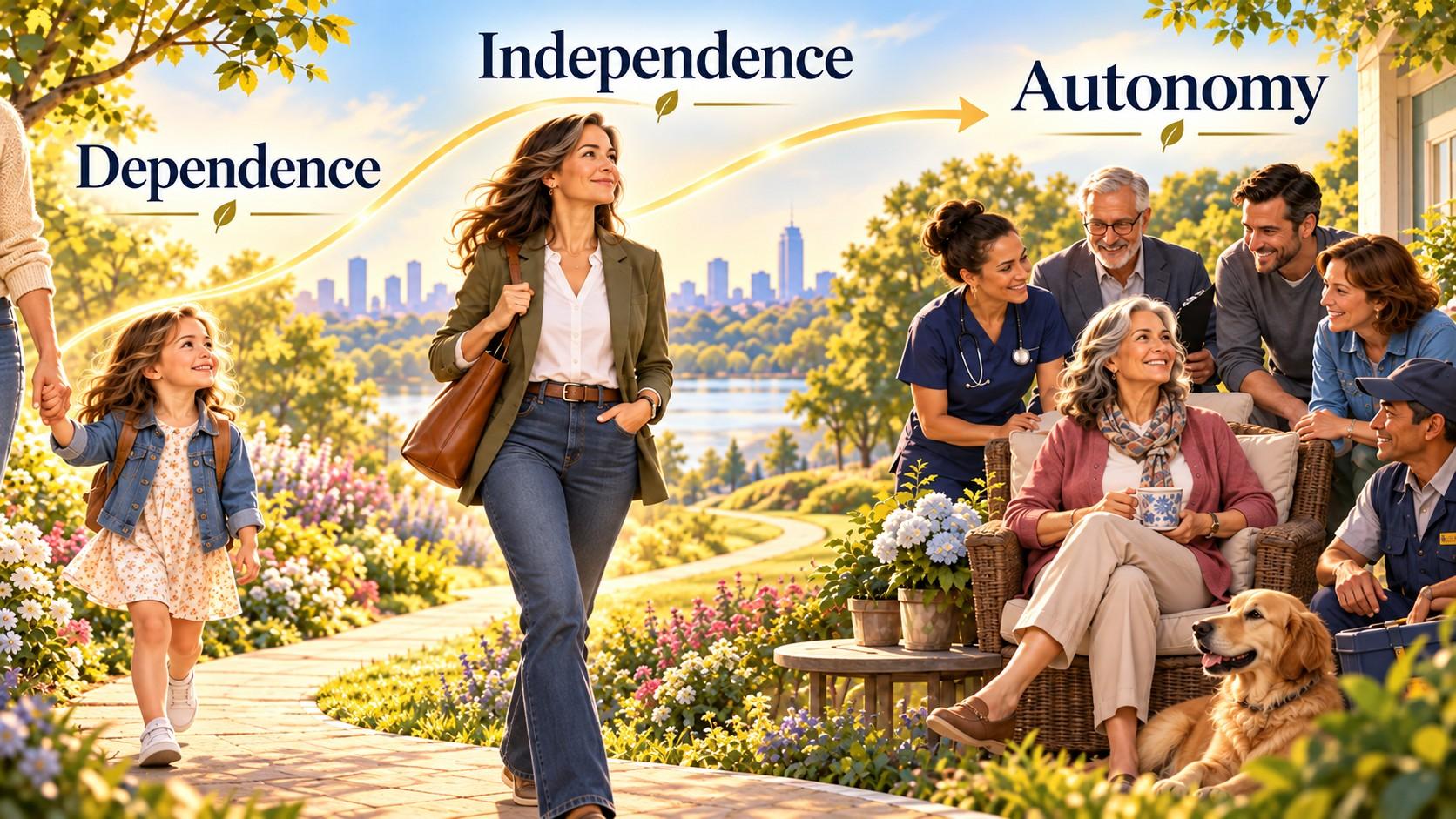
Dependence, Independence, Autonomy: Planning the Third Stage of Life
Life has an arc. We start out dependent. As children, we rely on our parents for nearly everything, and growing up is largely about needing them less. By adulthood, most of us have reached independence: we earn a living, meet our needs, and make our own decisions. Independence becomes such a core part of our hard-won identity that we assume it's permanent.
It isn't. In later life, the arc bends again. Abilities decline, sometimes slowly and sometimes all at once, and we start needing help with things we used to do on our own. Many people experience this as sliding back toward the dependence of childhood, which is why they resist it so fiercely. I see it differently. Mindful planning for the third stage of life can prevent regression into dependence and instead help us move toward autonomy. That means no longer doing everything ourselves, but still deciding how we live and who helps us do it.
For most of us, the hope is to live that stage at home. Yet far fewer do the necessary planning. According to AARP's 2024 Home and Community Preferences Survey, 75% of adults 50 and older want to remain in their current home as they age. By contrast, a 2023 Census Bureau report found that only 40% of U.S. homes have three basic aging-ready features: a step-free entrance, a bedroom on the first floor, and a full bathroom on the first floor. Only 6% of households with someone 65 or older planned to renovate in the near future to improve accessibility. That's quite a gap between preference and preparation.
We often talk about aging in place as if it were a simple decision, like checking a box. In reality, it means proactively tackling a to-do list. Staying home depends on many things coming together to make it possible. We need to get around the house, get food, get to medical appointments, take care of the home and pets, manage our finances, and deal with whatever health problems come along. When some of those abilities decline, something else has to take their place, and that takes preparation.
The challenges are the road
Longer lifespans make it more likely we'll need assistance as we age. It sometimes comes as a health crisis, but it can also be a slow accumulation: a bad knee, then a fall, then trouble with the stairs, then trouble keeping the pills straight.
A client recently told me he realized the challenges of aging aren't a bump in the road; they're the road. I think he's right. Not everyone declines at the same pace or in the same ways, and people certainly recover from setbacks. But the broad direction is toward losing abilities rather than gaining new ones.
Consequently, care often leads to more care. The first need may be small, like a ride to the doctor. Then night driving stops, the appointments multiply, and groceries become hard to manage. Bills start piling up. A fall leads to a hospital stay and several weeks of help at home, and eventually someone may need help bathing or dressing. Once help starts, the need for it tends to grow rather than go away.
Independence isn't up to us, but autonomy can be
Much of the emotional work of aging is about holding on to a sense of control as control slips away. For many older adults, control gets defined in a very specific way: no new expenses and no new people in the house. Not the aide, not the housekeeper, not the nurse, not even the meal delivery. Accepting such help can feel like defeat, announcing that something has been lost.
I understand that completely. We often gained our independence through a strong will to do things on our own. Unfortunately, retaining independence doesn't work the same way; it isn't really up to us. At that stage in life, whether we can keep driving, climb stairs, or keep track of bills depends on our bodies and minds, not our determination.
Autonomy is different, and it's what keeps the last stage of life from becoming a return to the first. Autonomy means keeping meaningful control over how we live, and that is something we can plan for. Someone who can no longer drive but can easily arrange a ride has lost some independence but kept most of their autonomy. Someone who moves to a community where transportation, meals, activities, and help are readily available may actually gain autonomy compared with staying isolated in a house that has become hard to manage.
So support doesn't have to mean a loss of control. The right support, chosen ahead of time, often preserves it. In my view, clinging to independence past its expiration date can undermine the very control we're trying to keep. We often stand in the way of what we want most. In due time, control is best maintained by shifting from an independence mindset to an autonomy mindset. Everything else in this article is about how to make that shift.
Prepare the house, and practice the rest
The obvious place to start is the house. Steps become difficult, bathrooms become hazardous, and a second-floor bedroom that was never an issue can suddenly be a big one. AARP found that nearly half of adults 50 and older expect to modify their home as they age, most often the bathroom and access into and around the house. I'd encourage people to make those changes before they become urgent. Install grab bars while they're merely convenient, improve the lighting before your eyesight requires it, and think about whether the house could work on one level. A ramp or an accessible shower is much easier to plan calmly than to arrange while someone is being discharged from the hospital.
But the physical house is only part of it. Driving is a good example of how much else is involved. Most people don't give it up all at once. They stop driving at night, then on the freeway, then in unfamiliar areas, until one day it's no longer safe. If driving is the only way to buy groceries, pick up prescriptions, or see the doctor, losing it means losing a large share of your autonomy.
I suggest practicing these alternatives before you need them. Download a ride-share app and take an Uber to dinner, even though you could drive. Have groceries delivered one week, try a meal service, and have a prescription mailed to you. The point isn't just knowing these services exist; it's knowing how to use them and whether they work where you live. You don't want to learn a ride-share app the week you're told to stop driving, or find out after surgery that grocery delivery in your area is unreliable. The same goes for smart locks, video doorbells, automatic lighting, and voice controls. AARP reports that smart-home ownership among adults 50 and older rose from 10% in 2019 to 27% in 2025. Set these up while they're still fun, and if they later become necessary, they'll already be part of your life.
Practicing has another benefit: it lets you test the life, not just the technology. There's a difference between wanting to stay in a house and wanting the life that may eventually be available there. Someone sure that giving up driving won't matter because Uber exists may find, after a few weeks, that they were right. Or they may find that rides are scarce, expensive, or a hassle where they live. That isn't a failure. Preparing seriously to age in place also makes it easier to recognize if and when it stops making sense.
Tag, you're it
Without a plan, the pattern is predictable. A need comes up, and a good soul steps in: a daughter, a son, a neighbor, a friend from church. Because care tends to be followed by more care, whoever helps first often becomes the default caregiver. Nobody sits down and decides it. She drove Mom to the doctor last time, so she does it again. He understands the finances, so the bills start going to him. The child who lives closest handles the first emergency and becomes the one everyone calls for the next. A series of reasonable favors becomes a role, and it's hard to leave because the needs don't go away when the caregiver is overwhelmed. I call this the "tag, you're it" caregiver dilemma.
A lot of people are already in it. AARP and the National Alliance for Caregiving estimate that 63 million Americans, roughly one in four adults, are caregivers, and 44% of them provide high-intensity care. One in five reports being in fair or poor health, and nearly one in four says caregiving makes it hard to take care of their own health. Caregiving is commonly studied as a form of chronic stress, and caregiver burden is strongly associated with depression. I've seen what those numbers look like. I've seen caregivers in tears, exhausted, angry, and resentful, sometimes all at once, often while hiding it from the person they care for. They can love that person deeply and still hate what caregiving has done to their lives. Love doesn't make anyone immune to burnout.
Why families wait
If the risks are so clear, why do families wait until care is unavoidable?
Often, it's money. Care is expensive, and people who spent a lifetime saving can struggle to spend those savings on help they don't yet see as absolutely necessary. I've seen long-term care insurance change that calculation almost overnight. When the policy is paying, care that seemed extravagant suddenly seems reasonable, and people accept help sooner.
Sometimes the resistance is more personal. Having a housekeeper, aide, or nurse in the home can feel like giving something up. So can meal delivery or relying on someone else to drive. What looks like a practical solution from the outside can feel like an admission of decline from the inside.
Then there are family dynamics. Hiring help can feel like a judgment on the children: If my daughter loved me, why would I need to pay someone? Caregiving becomes a test of loyalty. If a relative sets limits, it can feel like rejection. If the relative steps in, the demands may keep growing.
Old family relationships don't disappear when someone needs care. Sometimes they intensify. I've heard a mother guilt-trip her daughter about caregiving. Another daughter told me how difficult it was to become the primary caregiver for a mother with whom she'd had a strained relationship for decades. Caregiving doesn't necessarily heal old wounds. It can amplify them.
Money can complicate the family dynamic too. When one of my clients was widowed, her son arranged for her to move next door to his sister so the sister could become her caregiver. I told him I thought the idea was unrealistic and unfair. His parents had accumulated ample resources precisely so his mother could be well cared for if she survived his father. But after his father died, the son began treating his mother's money as something to preserve, and his sister was the cheaper solution. When money can solve problems, preserve relationships, protect relatives, increase comfort, and provide autonomy, it's likely well spent.
None of this means families shouldn't help. Of course they will. But their willingness to help shouldn't replace planning, and their love shouldn't be treated as an unlimited source of labor. A good aging plan doesn't exclude family. It protects family from becoming the plan.
Build an autonomy tribe
I often say that the independence stage of life is like an individual sport, while the autonomy stage is a team sport. If we want to stay home, it helps to plan ahead for the people and services that make it possible. I think of it as building an autonomy tribe. Some members may be family, friends, and neighbors; others will be professionals. It might start with someone who cleans the house, prepares meals, walks the dog, or handles yard work. As needs grow, it may include a care manager, a home health aide, or a nurse. It may also need financial and administrative help, such as an accountant, financial advisor, attorney, or professional fiduciary, for the day when bills, taxes, investments, or legal matters become too much.
This isn't about assembling a large team in advance. It's about identifying the functions that keep life running and asking what happens if you can no longer handle one of them. Who can drive? Who can help after a hospital stay or take care of the dog? Who understands the finances, and who has the legal authority to act if you can't? And who serves as backup for each of those people? One neighbor isn't a transportation plan. One adult child isn't a caregiving plan. A healthy spouse isn't an endless source of future care.
A good rule of thumb is that maintaining autonomy shouldn't come at anyone's expense. That means being realistic about what relatives can actually do. Work, health, and family circumstances may make it impossible for a daughter to be a caregiver for any period of time. A son who lives nearby may travel constantly. Those aren't shortcomings, just facts, and it's much better to learn them in advance than in an emergency.
That matters because emergencies follow the path of least resistance. When someone falls, comes home from the hospital, or suddenly can't drive, families don't have time to design the ideal long-term solution. They use whatever is at hand: a daughter comes over, a son takes time off, a spouse does more. That may be exactly what needs to happen that day. The problem is that today's emergency fix can quietly become tomorrow's care plan. Preparing ahead builds better paths. If a home-care agency has already been chosen, calling it is easy. If transportation has been tested, using it is easy. If a fiduciary is already known and the legal documents are in place, a family member doesn't automatically become the financial manager. Preparation gives us options at the very moment we'd otherwise have the fewest.
Stress-test the plan
Financial planners routinely test retirement plans against bad markets, inflation, and long lives, because a plan that only works when everything goes right isn't much of a plan. Aging-in-place plans deserve the same treatment. Of course, we can't plan for every eventuality, but the more contingencies we identify and test, the more options we'll have when we have to make fast decisions. I compare planning for the autonomy stage of life to playing jazz: rather than playing a set score, we improvise within a framework. What differentiates it from chaos is the framework.
Jazz benefits greatly from practice, and so does autonomy. What happens if you can't drive for a month, or can no longer use the stairs safely? What if you come home from the hospital unable to shower on your own, or the spouse you expected to care for you needs care too? What if you can't manage the bills for six months? It's worth answering those questions, and worth actually trying some of the answers.
Sometimes the honest answer is that home won't work, and acting on that can be the best decision someone makes. Years ago, a couple came to see me shortly after the wife was diagnosed with dementia. The husband had heart problems, and his main worry was what would happen to her if he died first. So they did something I greatly admired: they sold their home and moved into a care facility together, while she still had good days and he was still well enough to manage the move. As her dementia progressed, I reminded him more than once how remarkable his planning had been. Whenever I had the chance, I told their children how lucky they were to have parents willing to make that hard choice themselves rather than leave it to them. That kind of clarity is rare. More often, wishful thinking and denial protect the preference to stay put until a crisis forces a decision for everyone.
That couple lost some independence, which would have happened regardless. But they kept their autonomy, and they spared their children the tag-you're-it dilemma. Rather than a defeat, moving let them stay in charge of their own lives.
Plan for the traffic
Most of us don't need to spend our later years anticipating every possible problem. That would make preparation a burden in itself. Planning does the opposite: it removes some of the uncertainty. Prepare the house, set up the technology, learn the services, build your autonomy tribe, talk candidly with your family about what they can and can't reasonably do, and test it all while mistakes are still cheap. Then go live your life.
We don't do these things because we expect everything to go wrong. We do them for the same reason I leave early for the airport: if traffic isn't bad, I arrive early and lose nothing; if it is, I still make my flight. As children, other people decided how we lived. As adults, we decided for ourselves and did most of it ourselves. With some planning, we can still decide the third stage, even when we can no longer do it all on our own. Hope isn't a plan; it's what the plan gives us.
Disclaimer: The views expressed in this article are those of the author and do not necessarily reflect the views of any firm or organization. This content is provided for general informational and educational purposes only and should not be construed as personalized financial, tax, accounting, or investment advice. Although the author is a CPA and holds the PFS credential, no professional services are being offered through this article. Readers should consult their own qualified advisors before making decisions based on this information. The content may include information from sources believed to be reliable but is not guaranteed and may be subject to change without notice.
Copyright: © 2026 Jean-Luc Bourdon, Original text, structure, organization, and editorial revisions created by the human author. The author used AI as a drafting tool, but exercised creative control by rewriting, restructuring, and contributing original analysis, tone, and expression. Disclosure in accordance with U.S. Copyright Office guidance on AI-assisted works.